

Generations in the Making
Understanding a community is one thing. Deciding how to support it financially is another. TexasBank does both.
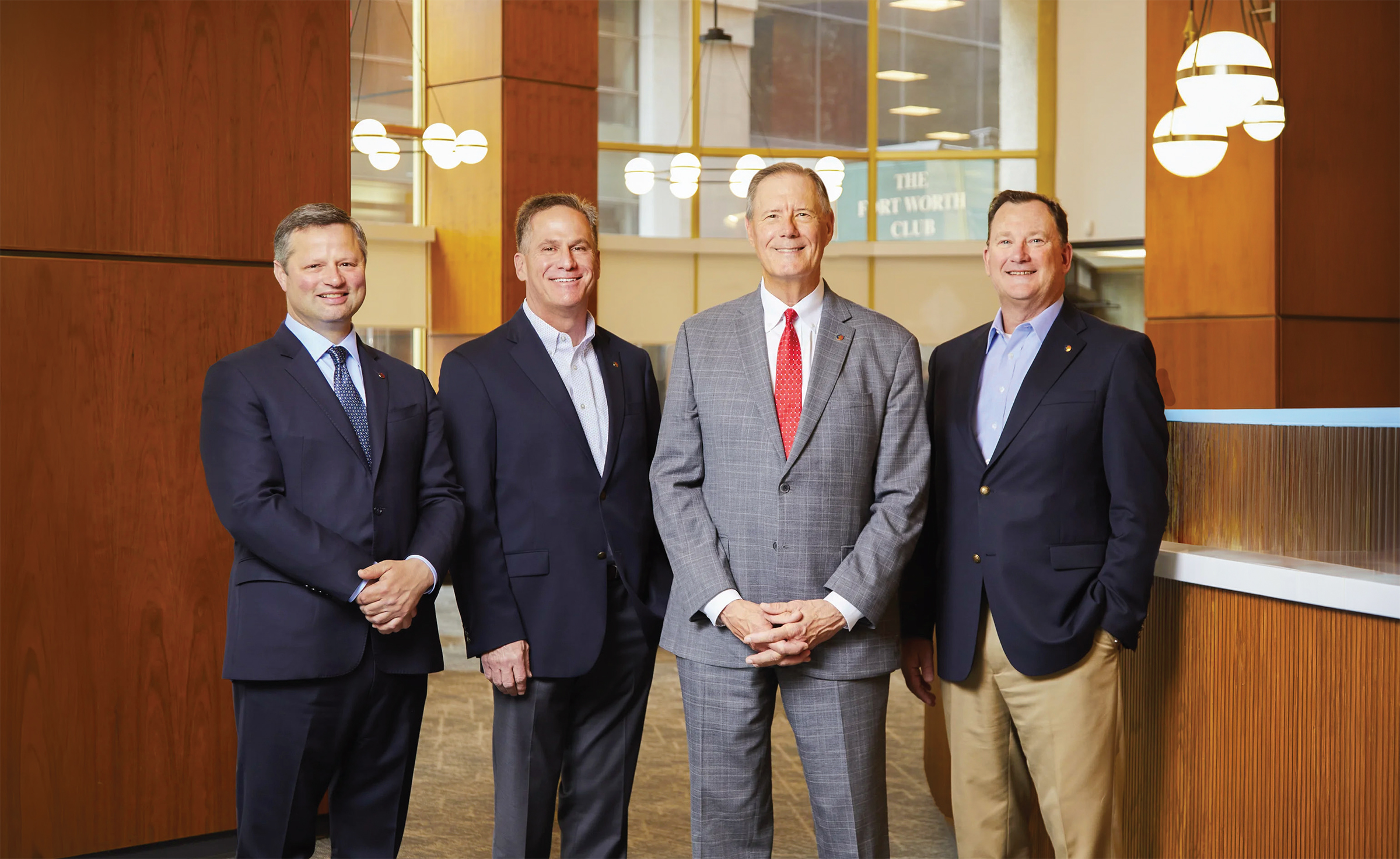
FROM LEFT: David Knight, Vice Chairman; Lin Bearden, Chief Lending Officer; Mark Riebe, Chairman; and Greg Dodds, President and CEO.
Spend a few minutes with the leaders of TexasBank and it's clear everyone has a story about a customer, a community, or a moment when the bank helped someone move forward. The stories come easily, and from different perspectives. Chairman Mark Riebe, Vice Chairman David Knight, President and CEO Greg Dodds, and Chief Lending Officer Lin Bearden are all Texas natives who have spent much of their careers working in the communities the bank now serves. And while each approaches their work from a slightly different vantage point, the underlying motivation is the same: to be useful to the people and places they know.
The origins of TexasBank are found in Merchant and Farmers National Bank, which began in Weatherford, Texas, in 1889. This bank was established with the idea that customers, employees, and communities must come first if a bank is to succeed. Under the leadership of a young banker named J.H. Doss, who became the Executive Officer there in 1913, Merchant and Farmers National Bank grew steadily for decades, eventually becoming TexasBank. Doss eventually owned the bank, and his son, James Doss, grandson-in-law Bill Knight, and now great-grandchildren have continued his legacy in banking. Holding onto that original sense of purpose, the bank continues to grow alongside the towns it serves, expanding into neighboring markets and, more recently, into the Dallas-Fort Worth area.
Knight, a fourth-generation banker and J.H. Doss's great-grandson, says the real story is found in handshakes and everyday conversations, including small rural towns where families have known each other for generations. "It's not uncommon for bankers to discuss a loan with someone whose parents and grandparents once sat across the same desk," he says. "Our job starts with knowing the people behind the accounts and listening carefully to what they are trying to build."
Along the fast-growing edges of the Dallas-Fort Worth metroplex, that work often revolves around business expansion, development of vacant ranch land into new neighborhoods, and the customers navigating opportunities that didn't exist a few years ago. Knight points to large population growth from in-migration from other states as well as other countries. "Texas is still being settled by those looking for a better way of life," he says. "Serving our customers is about finding shared relationships and experiences—it is about understanding how our communities live, work, and make decisions together."
Supporting the Local Economy
"Texas is incredibly diverse, both culturally and economically," says Riebe. "Some of the communities we serve are rural farming towns while others are vibrant centers of economic growth. But no matter where you are in Texas, people want the same thing from their bank: someone who understands their community and is willing to meet the needs of the people who live there. That's a goal we work toward every day." Bearden adds, "Our customers expect us to know them, understand their community, and keep local dollars local."
A loan-to-deposit ratio of roughly 102% reflects that commitment—nearly every dollar deposited at TexasBank is put back to work in the communities it serves through mortgages, small-business loans, and commercial financing. In contrast, large national banks may fund out-of-state, capital market activity. "We don't lend on skyscrapers in New York City or projects in San Francisco," says Dodds. "Our loans are right here in the communities we serve."
Bearden recalls a rural community of roughly 1,000 residents where two customers approached the bank with a vision of building a neighborhood of small homes. Other lenders declined the project, even though local leaders believed the development could help the town grow. TexasBank understood the vision and worked with the city and the local school district to help bring the development to life. "For the first time, the town had a neighborhood where families could settle, and children could play in the streets," Bearden says.
For Knight, the successful development meant families could remain in the community rather than move elsewhere in search of more affordable housing. He iterates that lending is more of an art than a science, which is why his team spends time every day discussing loan requests that may not check every box. "We figure out how to mitigate the weaknesses so we can still help that customer and get it done," Knight says. "You can plug all the numbers into a system and make conclusions, but you also have to look at the customer's character." The same people may be at the grocery store or at community and chamber-of-commerce events. "It may sound straight-forward," says Riebe, "but there's an in-it-together nature to this business."
One interaction in particular stands out to him. A customer approached him after church to say how happy she was that an employee resolved a problem with her debit card so quickly the previous week. But what stood out to her wasn't the speed of response, but that she could "hear the smile in the employee's voice."
Focused on the People
"Our vision is to set the standard for community banking," says Dodds. "To do that well, we must serve our customers with compassion, continue to invest in new technology, expand services, and strengthen protections that help safeguard customers from fraud and other emerging risks. But we don't just want to keep up with the pack. We focus every day on being our very best." For the bank's leadership team, those efforts remain tied to ideas that have guided the institution for decades. In 2000, after second-generation leader James Doss passed away, his wife, Dorothy, discovered a handwritten note beside the chair where he had spent many evenings thinking about the work he loved. The words described what he believed a bank should do for the people who trust it with their money. Today, those sentiments serve as TexasBank's mission statement: "To enrich every area in which we serve by exemplifying the highest degree of integrity and to participate financially as well as personally in the well-being of each community." As the leadership team continues to recognize that community banking must evolve, it never loses sight of its core values. "Growth is important, but at the end of the day, we're focused on whether we're taking care of the people we serve," says Dodds. More than two decades after Dorothy discovered the handwritten note beside her husband's chair, the words continue to guide the bank he helped shape. "When we talk about legacy, we're talking about lives changed and communities strengthened across Texas," says Knight. "TexasBank is so much more than just a bank. We're a partner for building a brighter, more enduring future for generations to come."